Wounded Knee

RELOCATION AND RESISTANCE
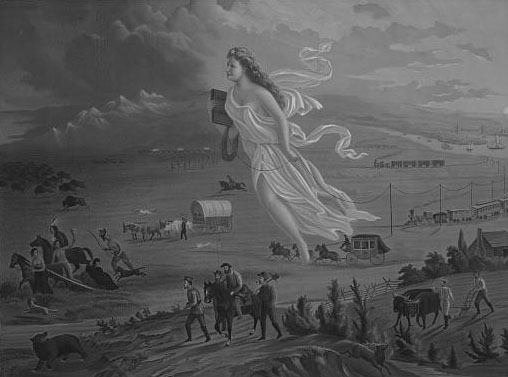
Illustration: Print shows an allegorical female figure of America leading pioneers westward, as they travel on foot, in a stagecoach, conestoga wagon, and by railroads, where they encounter Native Americans and herds of bison.

1830

Following a gold rush in Georgia, the American Indian Removal Act is signed by President Andrew Jackson. The aim of this legislation was to empower the government to draw up treaties mandating that America's tribal nations relinquish their land in exchange for lands west of the Missisippi.
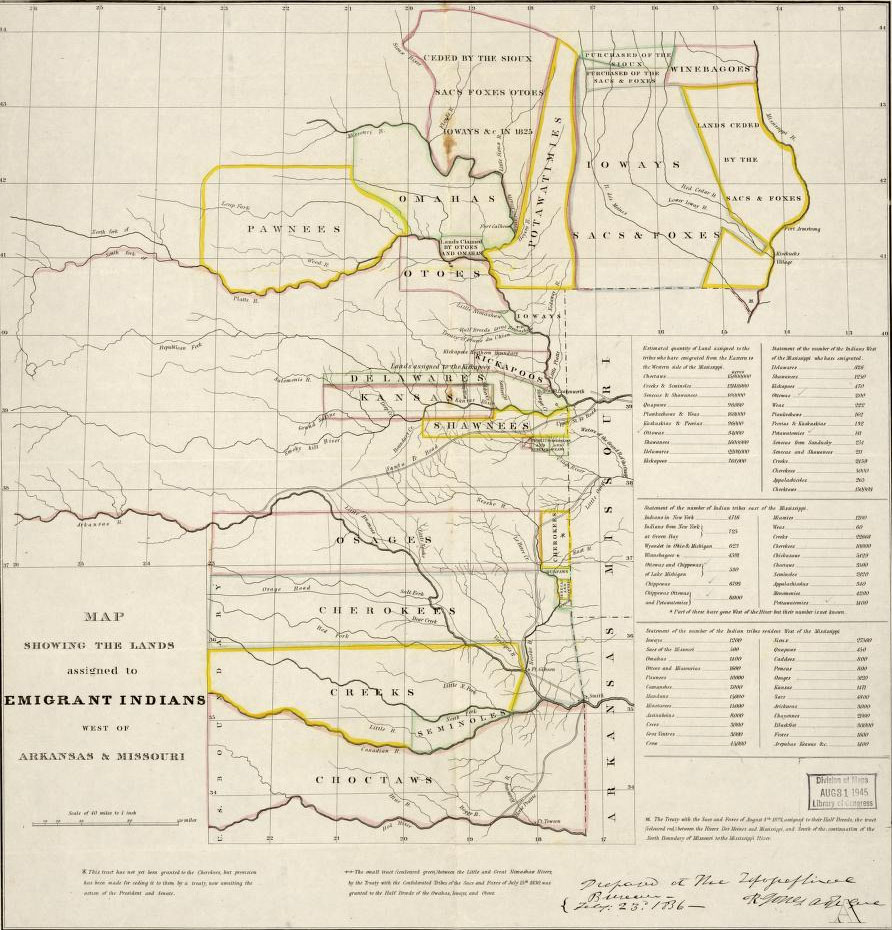
Map showing the lands assigned to emigrant Indians west of Arkansas and Missouri.

1830-1850

The "Five Civilized Tribes," the Cherokee, Muscogee, Seminole, Chikasaw, and Choctaw, are pushed out of their territory over the span of two decades, relocating under threat of U.S. military action to "Indian Territory" in current-day Oklahoma. These forced marches resulted in the deaths of thousands of people from starvation, illness, drought, and exposure.

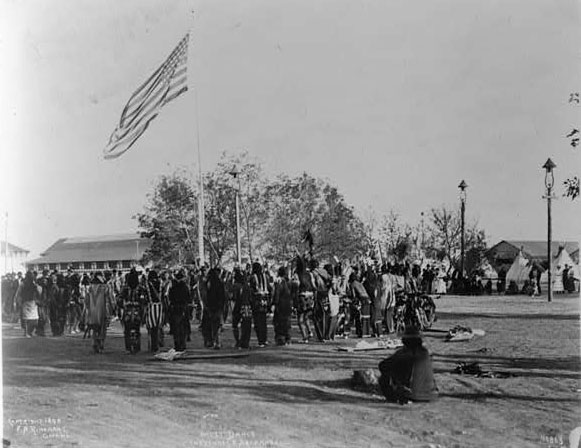
Photo: Cheyenne and Arapahoe people in circle around flagpole, at the Indian Congress of the Trans-Mississippi and International Exposition.

1890

Daniel F. Royer becomes Indian Agent at Pine Bridge Reservation. Fearing that the Ghost Dance religion signaled impending violence, he asks Washington to send troops to protect citizens.
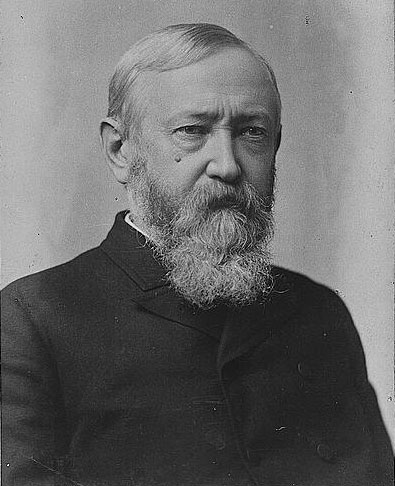
Photo: Benjamin Harrison, head-and-shoulders portrait, facing right.

1890

The 2nd Nebraska Infantry arrives in Pine Ridge after President Benjamin Harrison orders troops into the area.

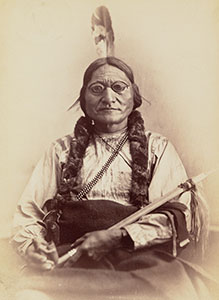
Photo: Sitting Bull, half-length portrait, facing front, holding peace pipe.

1890

Tȟatȟáŋka Íyotake (Sitting Bull) is killed by U.S. Indian Agents at Standing Rock.
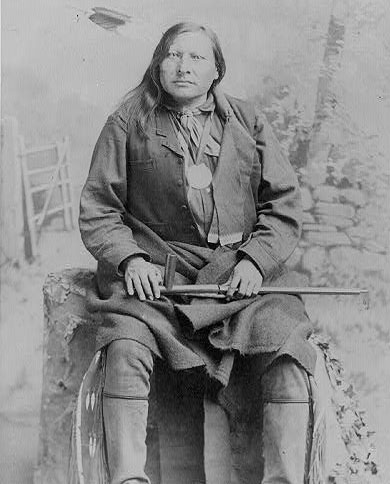
Photo: Portrait of Spotted Elk, full length, seated, facing slightly left; holding peace pipe.

1890

Members of Sitting Bull's Hunkpapa Lakota followers flee to join with Uŋpȟáŋ Glešká (Spotted Elk) and his Miniconjou Lakota band.

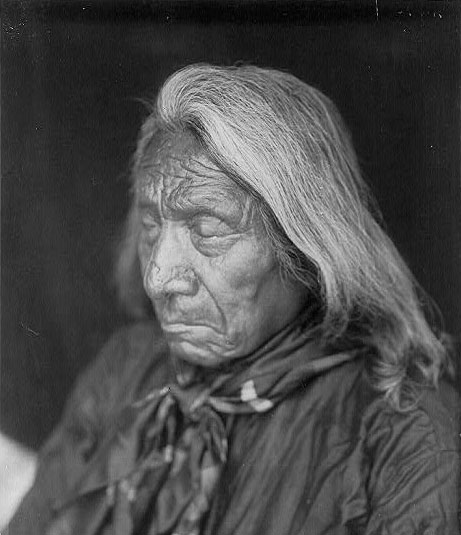
Photo: Red Cloud, head-and-shoulders portrait, facing left.

1890

Spotted Elk's band along with 38 Hunkpapa leave the Cheyenne River Reservation and go to Pine Ridge to seek shelter with Maȟpíya Lúta (Red Cloud) and the Oglala Lakota

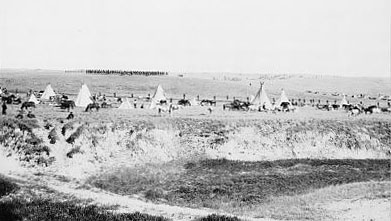
Photo: Reenactment of U.S. troops surrounding the Lakota at Wounded Knee (1913).

1890

Spotted Elk's band (numbering over 300) is met by the 7th Cavalry and escorted into confinement at Wounded Knee Creek.
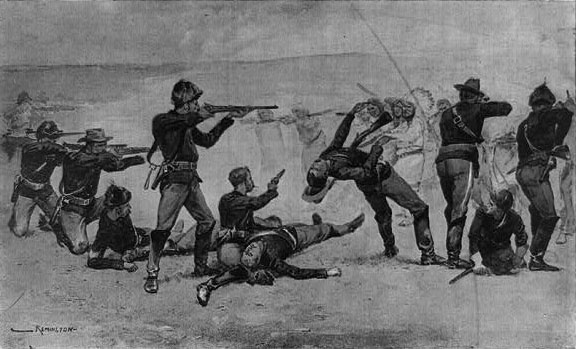
Illustration: Seventh Cavalry in battle with Indians.

1890

Col. James W. Forsyth convenes a council with the Miniconjous, demanding that they surrender all their firearms and relocate to a new camp. Several Miniconjou begin to sing Ghost Dance songs. When a (probably deaf) man called Black Coyote refuses to give up his gun, U.S. troops open fire with both rifles and artillery. The Miniconjou fight back, but they are outnumbered and begin to flee. The 7th Cavalry follows them and continue to fire. In all, U.S. troops kill more than 250 Lakota, including 44 women and 18 children. They are buried in a mass grave several days after the massacre.
The American Indian Movement (AIM)

WOUNDED KNEE 1973

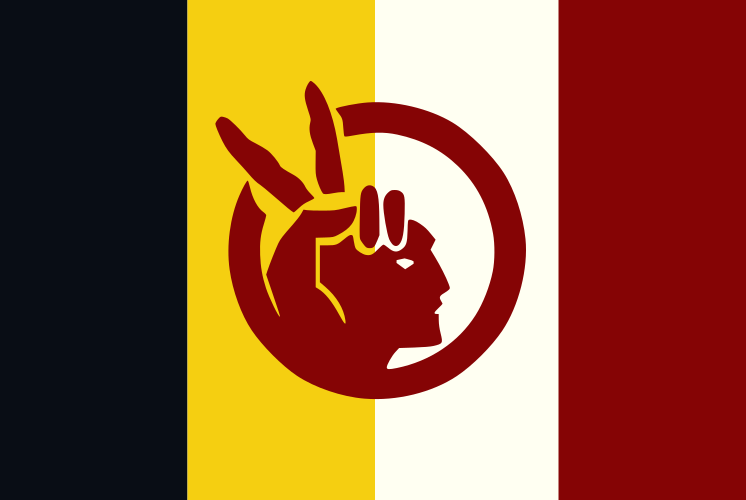
Image: Flag of the American Indian Movement. Vertical bars of black, gold, white, and red stand behind a red emblem of a man's face in profile. A hand is positioned on the head to suggest a peace sign and a feathered headdress.

1968

AIM was created in 1968 as a grassroots organization to support Indigenous Americans in both urban and tribal settings, focusing on systemic issues of poverty and discrimination as well as treaty rights, education, and preservation of culture.

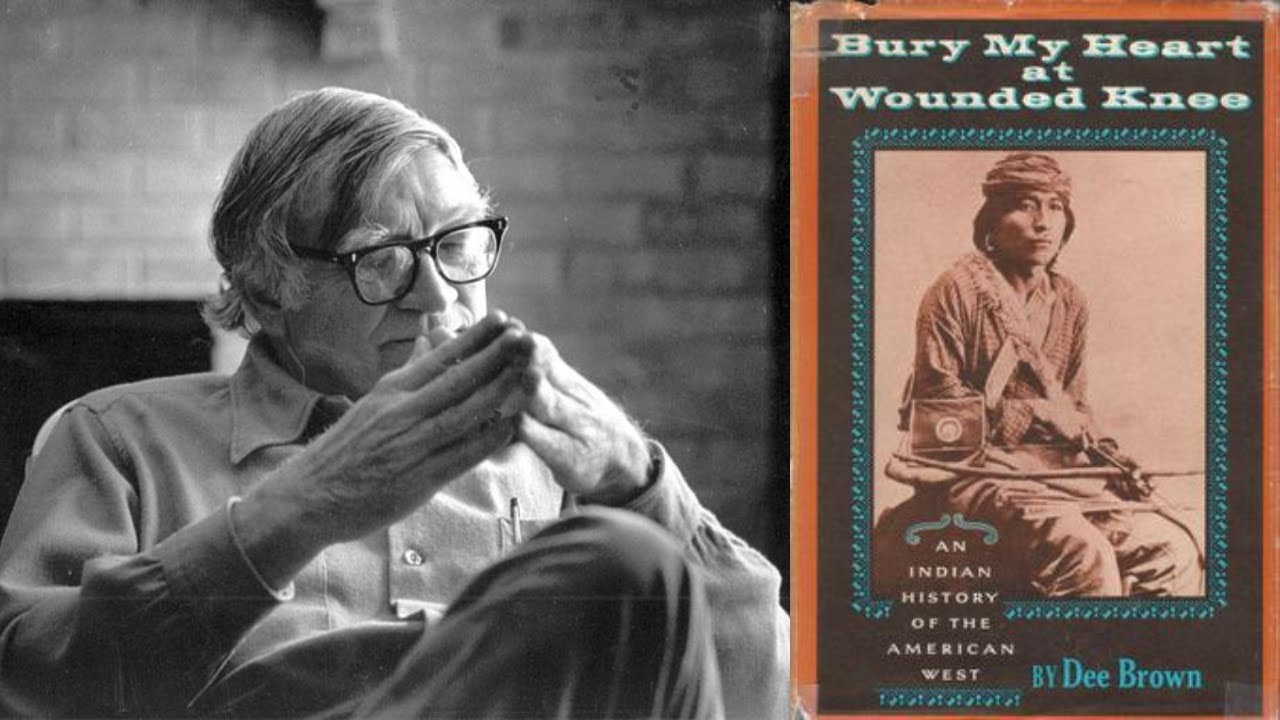
Photo: Dee Btown sitting in a chair, facing right, hands steepled in front of his face. Black and white. Displayed next to the cover of his book, Bury My Heart at Wounded Knee.

1970

Historian and librarian Dee Brown publishes Bury My Heart at Wounded Knee. While Brown himself was not native, the enormous popularity of the book helped to challenge the way Americans perceived their country's history. The book remained on the best-seller list through 1971.

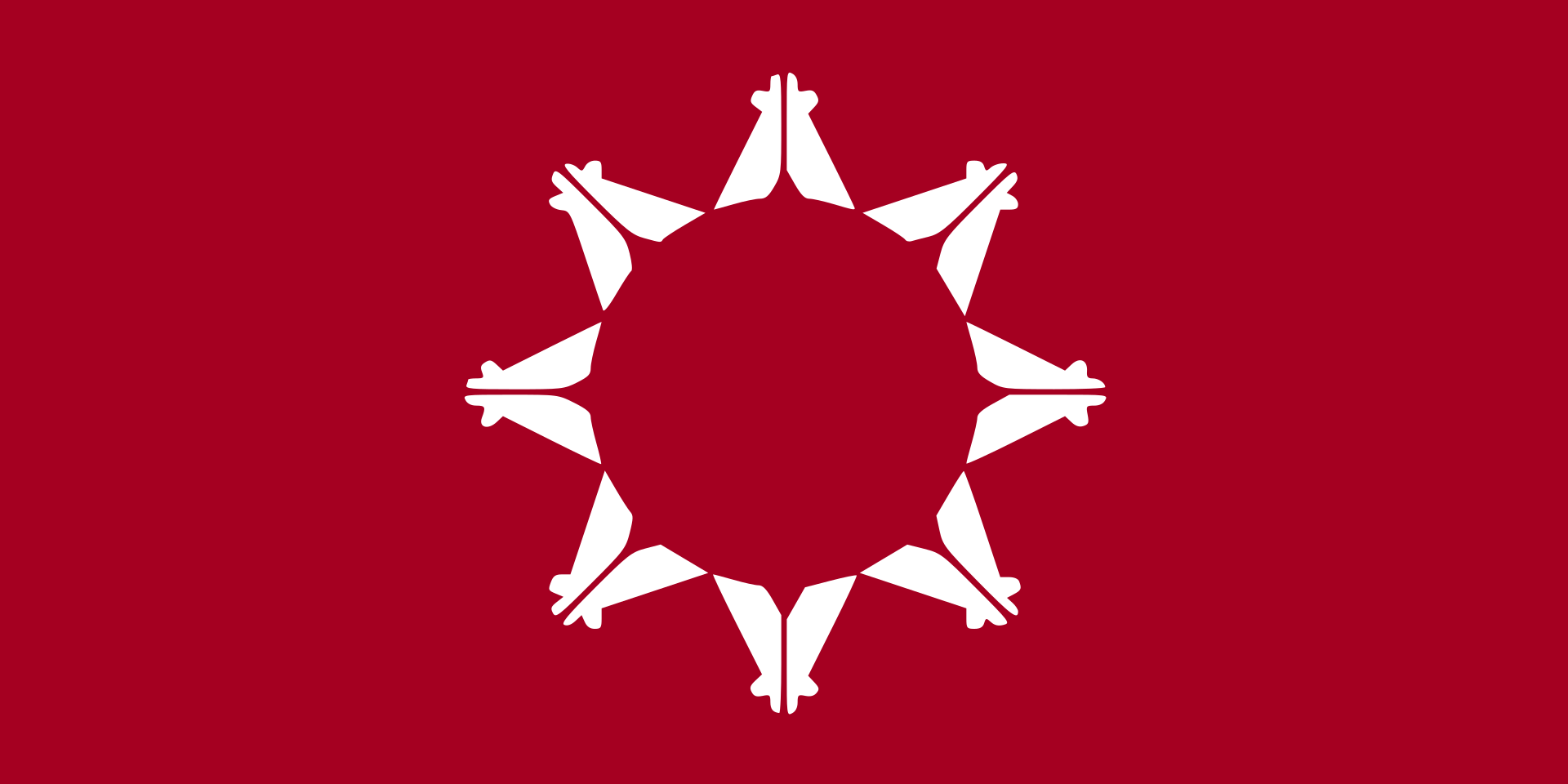
Flag of the Oglala Sioux. A white star comprised of teepees pointed outward, situated on a red background.

1973

On February 28, 1973, following the failure of the Oglala Sioux Civil Rights Organization to impeach corrupt Oglala Tribal President Richard Wilson, over 200 Oglala Lakota and members of AIM occupied the town of Wounded Knee on the Pine Ridge Reservation in protest of Wilson and the federal government's failure to uphold treaties and tribal sovereignty.

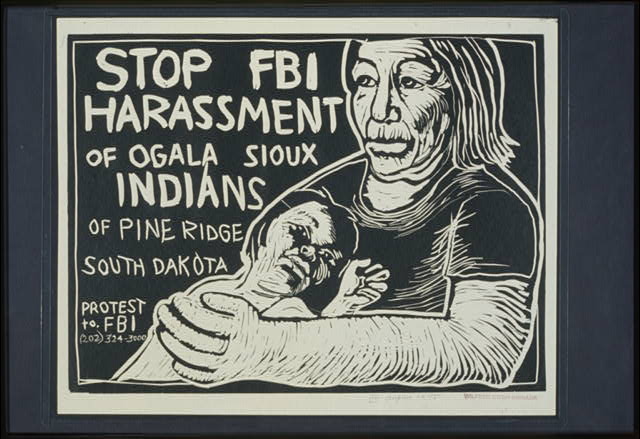
Illustration: Linocut poster. Man facing left holding another man in his arms. Text reads 'Stop FBI harrassment of Ogala Sioux indians of Pine Ridge South Dakota, protest to FBI, (202) 324-3000'

1973

U.S. government law enforcement, including FBI agents and U.S. Marshals, quickly surrounded Wounded Knee and established roadblocks that were enforced by Wilson's private paramilitary troops.

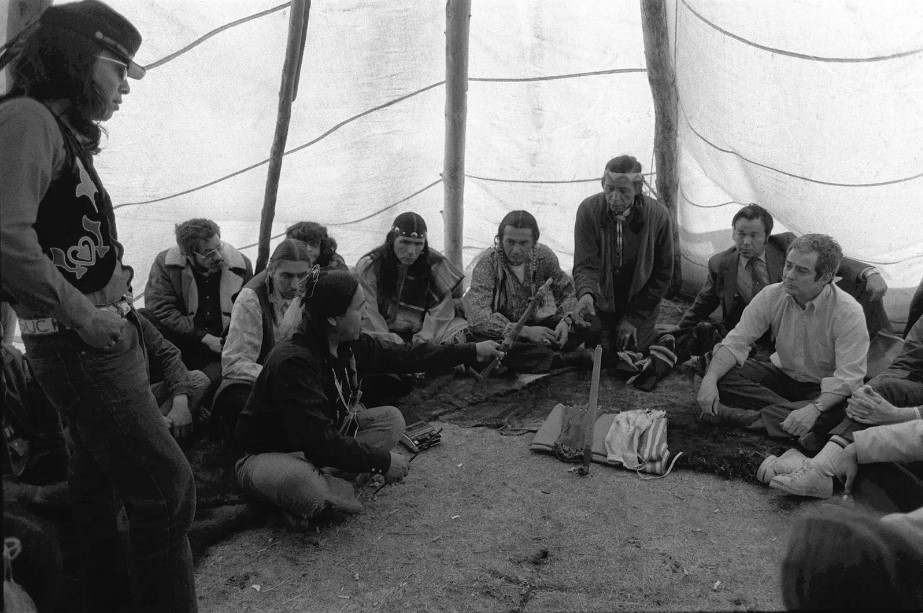
Photo: American Indian Movement members and U.S. authorities meeting to resolve the 1973 standoff at Wounded Knee, South Dakota.

1973

The U.S. government cut off electricity, water. and food supplies to Wounded Knee, attempting to starve out the activists. Shooting occurred from both sides, resulting in 2 FBI agents and 2 Oglala killed, as well as 16 total wounded. One black activist, Ray Robison, went missing during the course of the occupation and has never been found.

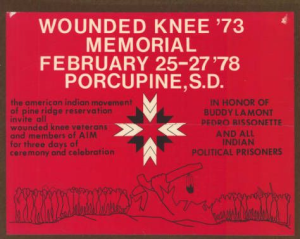
Photo: Wounded Knee 1973 Memorial. Text reads 'Wounded Knee '73 memorial February 25-27 '78 Porcupine, S. D.'

1973

After 71 days, the siege of Wounded Knee ended and the town was evacuated. Unfortunately, Wilson remained in power and Pine Ridge faced a period of increased violence. However, the occupation and siege ultimately raised awareness among the American public of issues facing Native Americans.

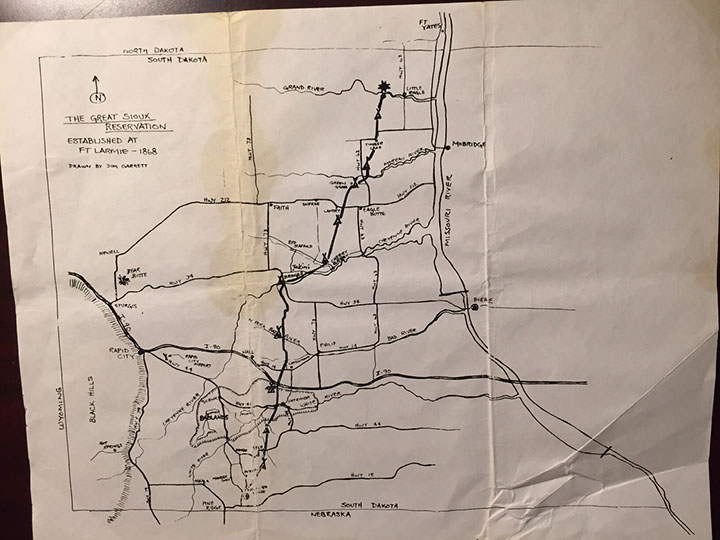
Photo: Ride map from 1990

1986

In 1986, three Lakota men decided to honor the legacy of Chief Big Foot (Spotted Elk) by traveling the trail walked nearly 100 years earlier. By 1990, for the 100th annuiverary of the Wounded Knee massacre, 300 Lakota Sioux ride the route on horseback and wagons. The Big Foot Band Memorial Ride was intended to only occur four times, as the number is sacred to the Lakota people, but has instead become a tradition that continues up through today.

Wounded Knee Today

"WOUNDED KNEE COMES HOME AT LAST"

40 acres of the Wounded Knee Massacre was privately held by various non-Native owners from the 1930S until September 2022.

James Czywczynski, who owned the land from 1968 until his death, refused to donate the land to the Oglala Lakota and instead listed the parcel for sale for 3.9 million USD. This made purchasing the site nearly impossible for the Oglala, as they have long lived in one of the lowest income areas in the United States.

Several plans to buy the property either fell through or never materialized, including a supposed purchase by actor Johnny Depp.

Following Czywczynski's death in 2019, his wife became the sole owner of the property. The Oglala Lakota of Pine Ridge and the Cheyenne River Lakota (a nation that includes the Miniconjou band) came together in September 2022 to purchase the site for $500,000 -\- although the 40 acres of land has been assessed at only $14,000).

The Oglala will hold the title to the site, which includes the primary location of the massacre. The hope is that it will be maintained as a sacred site of remembrance.